
How to Bury Negative Google Search Results
Learn how to bury negative Google search results with a safe playbook: remove, deindex, suppress, then monitor branded SERPs over time.
How to bury negative Google search results starts with choosing the right path for each URL: remove it, request deindexing, suppress it with stronger assets, or monitor it until movement appears. The practical goal is not vanity. It is reducing the visibility and impact of harmful branded search results safely.
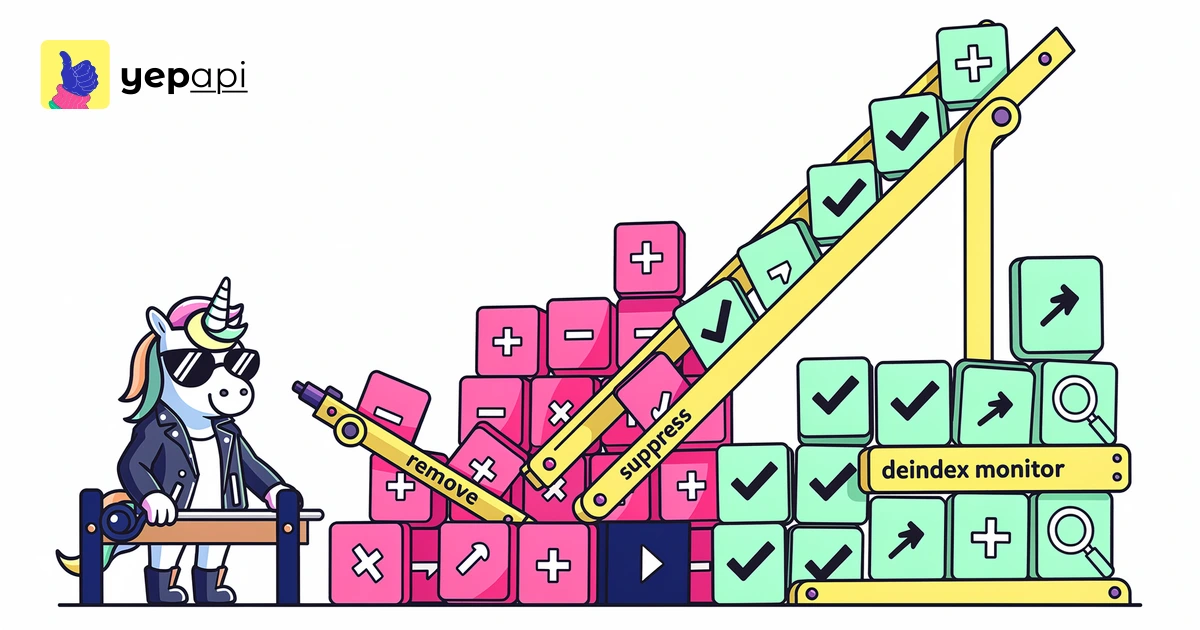
If you skip that decision, you waste months trying to outrank pages that could have been removed, or you overreact to pages that will fade on their own. Good online reputation management is mostly triage, then execution, then measurement.
Decision tree for how to bury negative Google search results#
Use this order before you build a single new page:
- Remove the content at the source if you control it or can resolve it with the publisher.
- Deindex the URL if it qualifies for search removal, legal action, or technical exclusion.
- Suppress the result if it will likely stay indexed and visible.
- Monitor the branded SERP until you can prove the negative URL moved.
That order matters because suppression is the slowest and most expensive option. If a page can be fixed upstream, fixing it is almost always better than trying to push it down with ten weaker pages.
YepAPI's Google SERP API is the practical way to track that decision over time in code, because you can capture the full branded result set instead of checking manually in a browser.
What it means to push down negative search results#
To push down negative search results, you make stronger, more relevant, more trusted pages rank above the unwanted result for branded queries. That usually means occupying more of page one with assets you control, plus credible third-party pages that mention the brand accurately.
Suppression is not deletion. The result may still exist, still be indexed, and still appear for deeper pages or variant queries. The goal is to reduce prominence for searches that matter most, especially name, brand, executive, or product queries.
When to remove negative Google search results instead of suppressing them#
The fastest wins come from pages that should not stay live in their current form. If you can remove negative Google search results at the source, do that first.
Common removal scenarios:
- You own the page and can edit or delete it.
- The publisher will correct false, outdated, or resolved claims.
- The content exposes private data, impersonation, or policy violations.
- The page was indexed after being blocked incorrectly or left live by mistake.
- A legal route exists, such as clear defamation or copyright misuse.
Be careful here. Not every bad review is defamation. Not every copied sentence supports a DMCA claim. Aggressive requests without a real basis can make the problem worse.
Deindexing options and limits#
Deindexing means preventing a URL from appearing in search, even if the page still exists somewhere on the web. That can happen through technical controls, publisher action, or qualifying legal and policy processes.
If you control the page, a noindex directive is the cleanest route. Browser and crawler behavior depends on machine-readable directives and document parsing rules defined by web standards, which is why technical fixes should follow the HTML processing model documented by WHATWG HTML.
If you need to automate checks on whether the unwanted page is still present in search, YepAPI's Google SERP API can query the branded SERP repeatedly by market, device, and location.
Suppress negative search results when removal is not possible#
If a review site page, forum thread, news article, or long-lived directory listing is likely to remain indexed, you need to suppress negative search results with better candidates. That means publishing and strengthening the pages most likely to outrank the negative URL for the exact branded query.
The biggest mistake is creating random content. Branded SERPs reward entity clarity, trust, and consistency more than volume.
Asset plan for branded search results#
Build assets in this order:
- Primary website home page
- About page and leadership pages
- Product or service pages with clear brand mentions
- Press or news pages on your site
- Social profiles on major networks
- Third-party profiles you can fully complete
- Review platform profiles you can actively manage
- Author pages or expert pages tied to the brand
For entity clarity, structured data matters. Organization schema helps search engines understand the brand entity, its sameAs references, and its official properties.
If you are trying to win more controlled real estate on page one, the same tactics that help pages earn SERP features opportunities can also help branded assets become more visible.
Which negative result types are easiest or hardest to displace#
Not all unwanted results have the same ranking difficulty. Prioritize by result type, not just by how upsetting the page feels.
| Result type | Typical difficulty to displace | Why |
|---|---|---|
| Weak directory or stale profile | Low | Thin content and low user demand make these easier to outrank |
| Old forum thread | Low to medium | Threads can decay unless the brand query strongly matches them |
| Social profile you do not control | Medium | Strong domains rank well, but intent can shift to your official profile |
| Review site profile | Medium to high | High-authority domains and branded relevance make them sticky |
| News article | High | News domains often have strong authority and link support |
| Government or legal record | Very high | Extreme trust, persistent indexing, and exact-name relevance |
Use this matrix to choose targets. A stale forum thread might move with one strong press page and one complete social profile. A national news story may require months of asset building and may never leave page one completely.
Build controlled assets that can outrank the negative URL#
A suppression plan works best when every asset has a role in the entity graph.
Website assets you control#
Create or improve:
- Homepage title tag and on-page brand naming
- About page with leadership and company history
- Contact page with consistent NAP where relevant
- News, press, or media page
- Expert bios and author pages
- Supporting pages that target brand plus service or product modifiers
Technical quality still matters. Fast, accessible pages are easier to crawl and render. Google-friendly layout and performance practices are well documented by web.dev's guidance on Core Web Vitals.
For content teams doing this at scale, YepAPI's Onpage Instant API lets you check page titles, headings, canonicals, and other on-page signals programmatically.
Third-party assets you do not fully control but can influence#
Complete and maintain:
- Social profiles
- Industry directories
- Marketplace or app listings
- Review site business profiles
- Knowledge sources tied to your brand entity
These pages matter because Google often mixes official and third-party sources on branded searches. If you leave major profiles empty, irrelevant or negative pages keep more room on page one.
Online reputation management: what actually moves the SERP#
Online reputation management works when it improves the documents Google already trusts for a brand. It fails when it relies on spammy microsites, duplicate bios, or fake engagement.
The strongest levers are usually:
- Better official brand pages
- Better completed third-party profiles
- Real press mentions and citations
- Review response and review velocity improvements
- Clear entity consistency across the web
If you want to see which domains already rank around your name, YepAPI's Domain Overview API and Domain Keywords API help you evaluate competing pages and branded query coverage.
How to measure branded search results beyond "page one"#
Most ORM advice stops at "get the bad result off page one." That is too blunt to manage well.
Track these KPIs instead:
- Negative URL position for the main branded query
- Share of branded SERP owned by your controlled assets
- Sentiment mix across top ten results
- Review site visibility versus official site visibility
- SERP feature presence such as sitelinks, profiles, and People Also Ask
- Time to displacement from baseline to target position
- Result volatility by device and location
When you want repeatable measurement, the endpoint behind that workflow is YepAPI's Google SERP API. If you also want suggestions for branded query variants to track, YepAPI's Google Autocomplete API can surface common name-plus-modifier searches such as complaints, reviews, scam, lawsuit, or pricing.
Monitor the full branded SERP over time#
Manual checks are noisy. Personalized history, device differences, and location differences can hide movement.
A better workflow is:
- Define the exact branded queries to monitor.
- Capture the top ten or top twenty results daily or weekly.
- Group results by result type: official, third-party neutral, third-party negative.
- Score ownership share and negative visibility.
- Alert on new negative URLs entering the set.
YepAPI's Google SERP API is built for that collection layer, and YepAPI's Google AI Mode API can help you inspect how branded answers surface in newer Google experiences when those matter to your market.
If your brand is already winning rich elements for its assets, study types of SERP features and how to get a featured snippet because feature ownership can push standard blue links lower.
A simple suppression workflow in code#
Because this is a how-to topic, here is the operational sequence:
- Export the current branded SERP and mark each URL as official, neutral, or negative.
- For each negative URL, decide remove, deindex, suppress, or monitor.
- Assign a difficulty level based on result type and domain strength.
- Build the smallest asset set likely to move the query.
- Publish and improve those assets.
- Recheck rankings by location and device on a fixed schedule.
- Stop when the negative result drops below your risk threshold, not when you feel better.
If you need to prototype that workflow quickly, tools like cURL's POST examples and Postman's API request documentation are useful references for testing requests before you automate them.
What not to do#
This is the part most ranking pages skip.
Do not:
- Buy fake reviews
- Create fake complaint rebuttal sites
- File weak DMCA notices as a pressure tactic
- Publish duplicate microsites stuffed with your brand name
- Attack reviewers or forum users publicly
- Hide a real issue instead of fixing the root cause
These tactics can create legal risk, policy issues, or a bigger reputation event than the original result. The safest long-term path is truthful improvements, proper requests, and evidence-based monitoring.
How long it takes to suppress negative search results#
Simple cases can move in weeks. Hard cases can take months.
A weak directory page might fall after you improve official brand pages and complete major profiles. A review site page or news story can stay visible much longer because the ranking domain has strong trust and exact brand relevance.
Use movement data, not hope. If the negative result has not changed after a clear asset push, reassess the query, the asset mix, and whether source-side action is still possible.
When to hire an online reputation management service#
Hire help when the problem is legal, high stakes, or too broad for your team to execute well. That includes executive reputation issues, large review crises, persistent news coverage, or multilingual branded SERPs.
Before you hire, ask how they separate removal from suppression, what they will not do, and how they measure progress. If the answer is vague, or if the plan relies on dozens of throwaway pages, keep looking.
Final checklist#
Before you start, ask four questions:
- Can this page be removed at the source?
- Can it be deindexed legitimately?
- If not, which assets have the best chance to outrank it?
- How will I measure movement in the branded SERP each week?
That checklist is the difference between reactive ORM and a workable playbook.
Do this at scale with YepAPI#
If you need to monitor branded search results across locations, devices, and query variants, YepAPI's Google SERP API is the cleanest way to collect the full SERP in code. Pair it with YepAPI's Google Autocomplete API for branded modifiers and YepAPI's Onpage Instant API for improving the pages you want to rank.
CTA: Pull branded SERP data via YepAPI's Google SERP API — $5 free credit, no card.
FAQ#
How can I remove negative Google search results?#
Start by checking whether the content can be fixed at the source. If you control the page, edit, delete, or noindex it. If a publisher controls it, request correction or removal with evidence. If neither path applies, shift to suppression and monitor whether the URL still ranks for your branded search results.
Can I make myself unsearchable on Google?#
Not completely, unless the pages about you are removed or blocked from indexing across the web. You can reduce visibility by removing pages you control, tightening public profile exposure, and asking sites to delete qualifying content. For most people and brands, the realistic goal is to influence what ranks first, not disappear entirely.
How do I narrow down Google search results?#
Use more specific branded queries, operators, and modifiers. Searching a brand name with terms like reviews, complaints, founder, or product lines helps isolate which result sets need attention. For ongoing work, track those variants separately because a negative page may rank for one branded search but not another.
What is Google's worst enemy?#
There is no single official "worst enemy" of Google. In practice, the biggest threats to visibility are low trust, poor relevance, and weak user satisfaction signals. For reputation work, the real enemy is an unmanaged branded SERP: once stronger third-party negative pages define the entity, they become much harder to displace.
Topics