How to Scrape Google Search Results
Learn how to scrape google search results with Python, when HTML parsing breaks, and why a SERP API is the reliable option at scale.
How to scrape google search results reliably means collecting structured SERP data, not just pulling raw HTML. Google pages change often, vary by location and device, and include modules beyond blue links. For production workflows, a dedicated SERP API is usually more stable than maintaining your own parser and proxy stack.
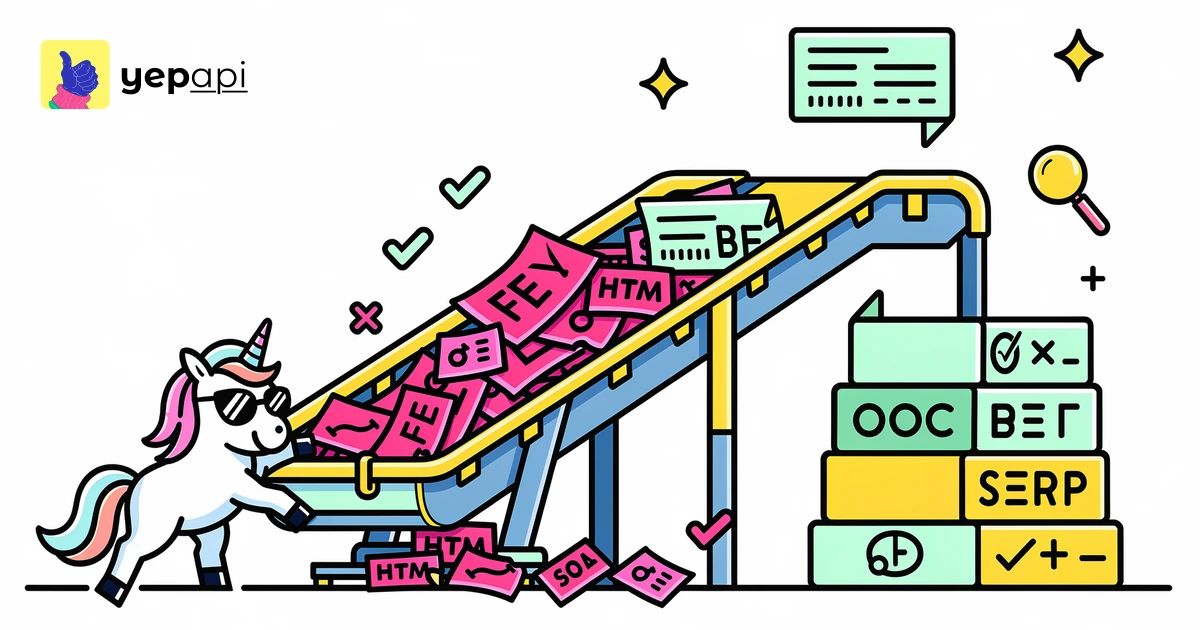
Scraping Google can mean two different jobs:
- Fetching a search page.
- Extracting consistent search-result fields from it.
The first job is easy in a demo. The second job gets expensive fast. Google result pages include organic results, ads, People Also Ask, local packs, video blocks, news, and other modules that move around depending on query intent, country, language, and device.
That is why most one-off tutorials age badly. They teach requests, headers, proxies, and a basic HTML parser. They do not solve the maintenance problem.
How to scrape google search results: the reliable approach#
For real pipelines, the reliable approach is:
- Query Google in a reproducible context.
- Receive normalized JSON for each result type.
- Store snapshots with query, locale, device, and timestamp.
- Re-run on a schedule and compare changes over time.
YepAPI's Google SERP API is built for that workflow. Instead of scraping brittle markup, you request the SERP and get structured fields you can process in code.
Why general-purpose scraping breaks on Google#
A generic page scraper can fetch many websites. Google Search is different because the result page is dynamic, heavily defended, and not designed as a stable data source for your CSS selectors.
Three things usually fail first:
- Access reliability. Repeated requests trigger rate limiting, CAPTCHA challenges, or inconsistent responses.
- Parser stability. CSS selectors and XPath rules break when Google changes markup or inserts new modules.
- Result consistency. The page changes by signed-out context, language, geography, SafeSearch, and device.
MDN's documentation on CSS selectors shows how selector logic works, but selector correctness is not the same as selector durability. A valid selector can still fail tomorrow if the DOM changes.
If you only need a one-time experiment, HTML scraping may be enough. If you need repeatable collection, a dedicated endpoint is the simpler system.
What modern Google SERPs contain#
A modern SERP is not just ten blue links. It is a container for multiple result modules.
Common modules include:
| Module | Why it matters for scraping |
|---|---|
| Organic results | Core ranking data, titles, URLs, snippets, positions |
| Ads | Separate placements with different position logic |
| Featured snippets | Extracted answer boxes above organic listings |
| People Also Ask | Expandable question blocks with nested answers |
| Local pack | Map-driven business results tied to location |
| News | Publisher cards with timestamps and sources |
| Videos | Video carousels with hosts, thumbnails, and durations |
| AI Overview | Generated summaries that can change layout and sources |
| Pagination | Additional pages and next-page retrieval |
If you are mapping feature opportunities, types of SERP features is a useful companion reference. If you need feature-level visibility in code, YepAPI's Google AI Mode API and Google News API cover specific Google surfaces beyond standard web results.
scrape google search results python: a minimal example#
The simplest production-friendly Python example is not an HTML parser. It is a request to a SERP endpoint that returns JSON.
import requests

url = "https://api.yepapi.com/serp-api/google"
params = {
    "q": "best running shoes",
    "hl": "en",
    "gl": "us",
    "device": "desktop",
    "page": 1
}
headers = {
    "Authorization": "Bearer YOUR_API_KEY"
}

resp = requests.get(url, params=params, headers=headers, timeout=30)
resp.raise_for_status()
data = resp.json()

organic = data.get("organic_results", [])
for row in organic:
    print({
        "position": row.get("position"),
        "title": row.get("title"),
        "url": row.get("link"),
        "snippet": row.get("snippet")
    })
This example uses Python's standard request pattern documented in the Python docs on urllib and URL handling and keeps the extraction layer focused on JSON fields rather than HTML nodes.
YepAPI's Google Autocomplete API also helps when your workflow starts one step earlier and you need query variants before collecting full SERPs.
What fields to extract and store#
A durable google serp scraping workflow starts with a data model, not a parser. Decide what a "result" is before you write code.
At minimum, store these fields per snapshot:
- Query text.
- Search engine and result type.
- Country and language parameters.
- Device type.
- Page number.
- Retrieved timestamp.
- Rank position.
- Result URL.
- Display title.
- Snippet or description.
- Result module such as organic, ad, PAA, news, or local.
Then add normalization rules:
- Canonicalize URLs where possible.
- Separate absolute rank from within-module rank.
- Keep raw JSON for reprocessing later.
- Deduplicate by query, locale, device, page, and URL.
If your end goal is ranking analysis, YepAPI's Keyword API can help you pair SERP snapshots with keyword data. If you want raw position collection across result pages, YepAPI's Google Search endpoint is another code-first option for Google query retrieval workflows.
google search html parsing vs SERP endpoints#
Here is the practical tradeoff.
| Approach | Best for | Main cost |
|---|---|---|
| Manual HTML scraping | Learning, demos, narrow one-off jobs | Breakage, blocks, parser maintenance |
| Generic browser automation | Rendering-heavy experiments | Slower runs, larger infra footprint |
| SERP endpoint | Repeatable collection and scale | API cost instead of scraper maintenance |
HTML parsing is still useful when you are testing assumptions or auditing markup. The WHATWG HTML standard explains why parsers must handle complex, changing document structures. That complexity is exactly why Google search html parsing becomes fragile when the target page keeps changing.
A SERP endpoint shifts the hard parts away from your application. Your code can focus on business logic: ranking checks, feature detection, monitoring, alerts, and storage.
Parameters that change the results#
Reproducible SERP data depends on parameters. If you do not save them, you cannot explain ranking differences later.
Important parameters include:
Location and country#
Google results differ by market. A local-intent query in the US can produce a local pack while the same query elsewhere may not.
Language#
The hl setting affects interface language and often changes result composition.
Device#
Desktop and mobile layouts differ. Module order differs too.
SafeSearch and search context#
Content filtering changes visible results. Signed-in and personalized contexts can also shift what appears.
Pagination#
Page one is not enough for many workflows. You need stable page numbers and position offsets.
If you are analyzing result layouts for opportunities, which SERP features are available for my keywords and how to find serp features opportunity show the strategic side of the same data.
The real cost of DIY scraping#
Proxy-heavy tutorials usually frame the problem as "avoid blocks." That is only part of the cost.
The larger cost is ongoing maintenance:
- Tuning headers and user-agents.
- Rotating IPs.
- Detecting failed fetches.
- Solving or avoiding CAPTCHAs.
- Updating selectors after DOM changes.
- Handling new result modules.
- Normalizing outputs across markets and devices.
- Re-running old data when your parser changes.
When teams compare approaches honestly, the question is not whether HTML scraping can work. It is whether you want to own that maintenance forever.
That is the core difference explained in serp api vs scraping google yourself. The build-it-yourself path gives control. A dedicated endpoint reduces operational burden.
Legal and policy considerations#
Web scraping is not automatically illegal. The legal answer depends on jurisdiction, contract terms, access controls, and what you do with the data.
Two practical rules help:
- Have counsel review your use case if it matters commercially.
- Treat robots, access restrictions, and site terms as operational constraints, not footnotes.
For teams building internal tools, the safer engineering choice is usually to minimize direct interaction with unstable front-end pages and use purpose-built interfaces when available.
Building a maintainable google search results parser workflow#
A maintainable workflow has four layers:
- Collection. Retrieve the SERP in a fixed context.
- Normalization. Map raw results into a stable schema.
- Storage. Save snapshots and metadata.
- Comparison. Detect ranking or feature changes over time.
A simple schema might look like this:
{
  "query": "best running shoes",
  "gl": "us",
  "hl": "en",
  "device": "desktop",
  "page": 1,
  "fetched_at": "2026-11-18T12:00:00Z",
  "results": [
    {
      "module": "organic",
      "position": 1,
      "title": "Example result",
      "url": "https://example.com/page",
      "snippet": "Short description"
    }
  ]
}
If your system also tracks visibility across queries, pair SERP collection with YepAPI's Keywords Overview API so your ranking snapshots and keyword metrics use the same pipeline.
When to use raw scraping anyway#
Use raw scraping when all of these are true:
- You are learning how SERPs are structured.
- You only need a short-lived script.
- You accept breakage.
- You do not need broad geo or device coverage.
- You can tolerate inconsistent module extraction.
Use a SERP endpoint when any of these are true:
- You need repeatability.
- You need multiple countries or languages.
- You need structured modules beyond organic links.
- You need scheduled collection.
- You need maintainable code.
If your next step is acting on the data rather than collecting it, how to rank higher on google search covers the optimization side after the measurement layer is in place.
How this fits into a broader search pipeline#
SERP collection is rarely the final deliverable. Usually it feeds another process:
- rank tracking
- competitor monitoring
- feature detection
- content briefs
- ad monitoring
- market expansion research
That is where structured outputs matter. When your data arrives as normalized JSON, you can ship it into queues, warehouses, notebooks, or dashboards without rebuilding your parser every month.
Use YepAPI's SERP API when you need scale#
For a one-off script, HTML scraping can be educational. For production-grade google serp scraping, the better default is a dedicated SERP endpoint.
YepAPI's Google SERP API gives you a more stable way to collect organic results, ads, and SERP modules in code. You can start small, store clean snapshots, and avoid most of the parser and proxy maintenance that DIY tutorials leave to you.
CTA: Pull reproducible Google result data with YepAPI's Google SERP API — $5 free credit, no card.
FAQ#
How do you get a search result removed from Google?#
You usually remove a result by removing or updating the source page, blocking indexing, or using Google's removal processes where they apply. You cannot directly delete a normal third-party result just by asking. If the issue is reputation management rather than collection, focus on removal eligibility, deindexing, or publishing stronger pages that outrank it.
Is web scraping illegal?#
Web scraping is not automatically illegal, but legality depends on jurisdiction, contract terms, technical access controls, and how you use the data. Public availability alone is not a complete defense. For commercial use, get legal review and prefer collection methods that reduce direct scraping of unstable front-end pages when a dedicated interface exists.
How do I scrape images from Google?#
Image-result collection is different from standard web SERPs because the layout, result objects, and metadata are different. If you need image search data, use a result source designed for image retrieval rather than reusing a basic web-results parser. That keeps positions, thumbnails, source pages, and pagination consistent across runs.
How to get more results in Google Search?#
You can broaden results by changing the query, using pagination, altering location or language parameters, or removing restrictive operators. For data collection, the important part is saving those parameters with each snapshot. Otherwise, you cannot tell whether result differences came from ranking changes or from a different search context.
Topics