
What Are Negative Keywords? Definition & Use
Learn what are negative keywords, why they matter, match types, mistakes to avoid, and how to manage exclusions at scale in code.
Negative keywords are terms you tell an ad platform not to match, so your ads avoid irrelevant searches. They filter wasted traffic before the click happens. In PPC, negative keywords protect budget, improve query targeting, and keep search intent aligned with the offer instead of broad, low-value impressions.
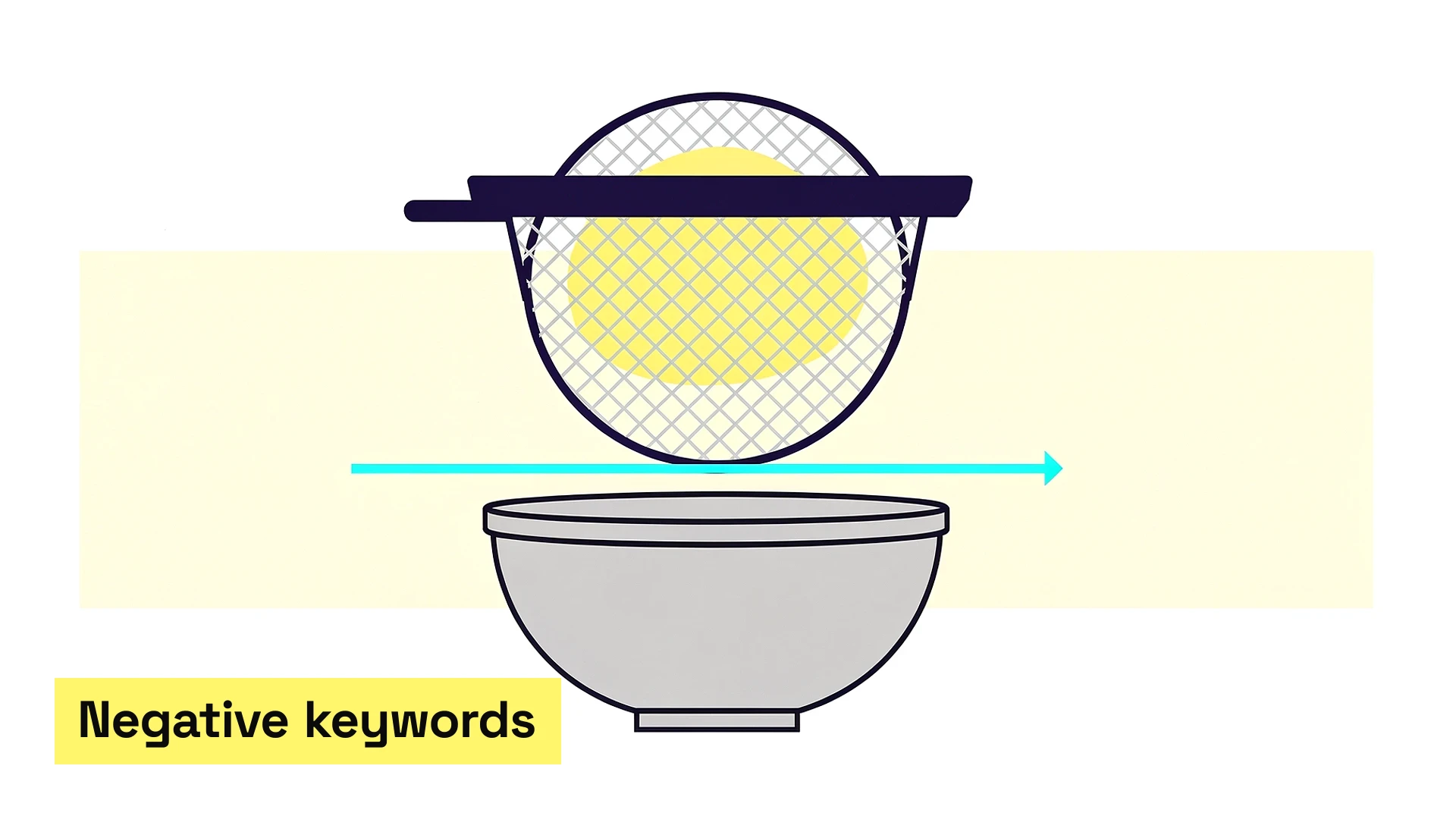
If you only remember one thing, remember this: a negative keyword is not a keyword you want to rank for. It is a term you want your ads to ignore. That makes negative keywords a control mechanism for paid search, not an SEO exclusion.
What are negative keywords#
Negative keywords are words or phrases added to a PPC account, campaign, or ad group to stop ads from showing for searches that include unwanted intent. In what are negative keywords in AdWords, the core idea is the same as today in Google Ads: block bad-fit traffic before it spends budget.
A simple negative keywords example is a software company selling enterprise payroll tools that adds free, template, and jobs as negatives. Those terms often signal research, employment, or zero-purchase intent instead of buying intent.
Google defines match behavior at the platform level, and developers can automate list operations through the Google Ads API documentation. That matters because the meaning of a negative depends on where you add it, which match type you use, and which platform you are using.
Why are negative keywords important#
Negative keywords matter because they reduce irrelevant traffic, wasted spend, noisy search terms reports, and misleading performance data. If poor-fit clicks stop earlier, your click-through rate, conversion rate, and lead quality usually become easier to interpret.
They also protect segmentation. A campaign for demos should not be triggered by searches for careers, support, definitions, or student research unless those searches are part of the plan.
Use negative keywords when intent is clearly wrong. Do not use them just because a query has not converted yet. That distinction is the difference between pruning waste and cutting future demand.
what are negative keywords in Google Ads#
In Google Ads, negative keywords can be added at the account, campaign, or ad group level depending on workflow and campaign type. Shared lists let teams apply the same exclusions across multiple campaigns, which is useful when terms like jobs, login, or meaning are irrelevant everywhere.
Google Ads negative match types are narrower than positive match types. Negative broad, negative phrase, and negative exact each stop different forms of a query, but they do not behave like their positive equivalents. Google documents that implementation in the Google Ads API keyword and criterion guides.
The practical point is simple. Never assume a negative broad match works like a positive broad match. Test the actual search terms that would be blocked.
Google Ads vs Microsoft Ads behavior#
Most guides stop at Google Ads, but teams running both Google Ads and Microsoft Ads need a platform-aware process. The strategy is similar across platforms, yet workflow, review cadence, and account structure can differ.
- Google Ads commonly uses shared negative lists for cross-campaign exclusions.
- Microsoft Ads also supports negative keywords and list management, but teams often mirror structure imperfectly after import.
- Platform differences can create drift when one account gets a new exclusion and the other does not.
- Search partner mix and query patterns can differ, so the same negative list should not always be copied unchanged.
The operational rule is to keep one master taxonomy of exclusions, then sync platform-specific versions after review. YepAPI's Keyword API is the scale answer here because you can classify query intent in code, group negatives by theme, and push approved exclusions into your own workflow instead of editing one interface at a time.
Negative keyword match types and syntax edge cases#
The three common negative match types are straightforward on paper but messy in practice.
| Match type | Example | What it usually blocks | Main risk |
|---|---|---|---|
| Negative broad | free trial | Searches containing both ideas, not necessarily in order | Can exclude valuable mixed-intent queries |
| Negative phrase | "free trial" | Searches containing that phrase in sequence | Can miss nearby unwanted variants |
| Negative exact | [free trial] | That exact query or very close form | Can be too narrow to matter |
Syntax matters. Quotation marks typically mark phrase negatives. Brackets typically mark exact negatives. A plain term is usually treated as broad negative. That is why the so-called negative keywords symbol question is really a match-type syntax question.
Edge cases matter more than most definitions admit:
- Punctuation does not always create a meaningful distinction.
- Singulars, plurals, and close wording can behave differently than teams expect.
- Misspellings often need explicit review rather than assumptions.
- Shared lists can block a useful query in one campaign while being correct in another.
If your process depends on exact parsing, treat your negative list like code. Python's regular expression syntax reference is useful when building classification rules for imported search terms, even though the ad platforms themselves are not regex-driven.
How to find negative keywords#
The best source is the search terms report. That is where you see the actual queries that triggered ads, not just the keywords you bid on.
A decision framework: keep, pause, or negate#
When you review a query, force it into one of three buckets.
- Keep: The query matches the offer and the landing page. It may deserve more volume, a dedicated ad group, or even promotion into a target keyword set.
- Pause for more data: The query might be relevant, but volume or conversion evidence is too thin. Watch it longer instead of excluding it too early.
- Negate: The query shows wrong intent, wrong audience, wrong geography, wrong stage, or wrong business model.
Use this rubric to decide fast:
| Signal in the query | Action | Example |
|---|---|---|
| Clear buying intent for your offer | Keep | payroll software demo |
| Ambiguous but potentially relevant | Pause | best payroll tools |
| Informational with no commercial fit | Negate | what is payroll |
| Support or login intent | Negate | payroll software login |
| Careers or hiring intent | Negate | payroll software jobs |
| Free-seeking with no free plan | Negate | free payroll software |
This is also where search intent definition becomes operational. Search intent is not just an SEO concept. It is the fastest way to decide whether a search term should stay, pause, or become a negative.
Other sources for negative keyword ideas#
Search terms are first. Everything else is second.
- Internal site search can reveal support, careers, and policy queries.
- Sales-call notes can reveal unqualified lead patterns.
- CRM reasons for disqualification can point to recurring mismatches.
- Existing negative keywords list assets can speed up review, but they should never be pasted in blindly.
For teams doing keyword research and strategy, negative research and positive targeting should feed the same taxonomy. The themes that produce bad-fit paid traffic often also reveal content gaps, pricing confusion, or poor landing page segmentation.
How many negative keywords should you have#
There is no good universal number. The right count depends on account size, campaign granularity, and how mixed your query landscape is.
A better framework is this:
- Small, narrow accounts: start with a short core set of universal exclusions such as jobs, support, login, free, and irrelevant geographies.
- Mid-size accounts: maintain a shared list plus campaign-specific negatives for product lines, audiences, and pricing tiers.
- Large accounts: use layered negatives at multiple levels, but review collisions constantly so shared exclusions do not suppress qualified traffic.
Review cadence matters more than total count. A clean set of 40 negatives that gets reviewed every week beats a neglected list of 800. If the list is large, it should be organized by reason, not by accidental accumulation.
Failure modes: when negative keywords reduce qualified traffic#
Negative keywords are powerful enough to cause damage.
The most common failure is overblocking. For example, a B2B SaaS brand may add small business as a negative to avoid tiny accounts, then accidentally block high-intent searches from subsidiaries or teams inside larger companies.
The second failure is assuming close variants work the way you think they do. The third is pushing a shared list everywhere without checking campaign purpose. A brand campaign, a competitor campaign, and a top-of-funnel campaign often need different exclusions.
If you see impressions fall before lead quality improves, audit the negatives first. The problem may not be bidding or ad copy. It may be a bad exclusion rule.
Managing negative keywords programmatically at scale#
Manual review works for small accounts. It breaks once you have many campaigns, markets, and weekly query volume.
YepAPI's Keyword API is useful when you need to collect query ideas in bulk, cluster terms by intent, and feed a review system that separates target keywords from exclusions. That is the code-first version of how to find negative keywords without relying on spreadsheets as the source of truth.
A practical workflow looks like this:
- Export search terms from each platform.
- Normalize casing, punctuation, and duplicates.
- Classify terms by intent themes such as jobs, free, support, education, or unrelated products.
- Route each term to keep, pause, or negate.
- Sync approved negatives into platform-specific lists.
- Recheck blocked-query impact every review cycle.
If you need to do keyword discovery, grouping, and decision support in code, start with YepAPI's Keyword API. It gives you a scalable path for keyword operations instead of one-off UI edits.
Negative keywords example sets by intent#
Use categories, not random one-off terms.
- Job seeker intent: jobs, careers, salary, interview
- Support intent: login, support, phone number, help
- Learning intent: definition, meaning, tutorial, course
- Free-only intent: free, template, sample, open source
- Wrong audience intent: students, diy, personal, consumer
These are starting points, not universal rules. A training company might want course. An open-source product might want open source. Context decides everything.
CTA#
Need to classify search terms, group exclusions, and manage keyword operations in code? Use YepAPI's Keyword API to scale research and workflow automation with $5 free credit and no card.
Visible breadcrumb: Home › Blog › Keyword Research › What Are Negative Keywords?
FAQ#
What is a negative keyword example?#
A negative keyword example is jobs for a B2B software advertiser that only wants buyers, not applicants. If someone searches for “payroll software jobs,” that term signals employment intent, so adding jobs as a negative can stop wasted clicks and keep the campaign focused on commercial searches.
Where do I find negative keywords in Google Ads?#
You usually find negative keyword candidates in the search terms report because it shows the real queries that triggered your ads. You can also review shared negative lists, campaign settings, internal search logs, and lead-quality feedback. The goal is to spot repeated intent mismatches before they keep spending budget.
What is a benefit of negative keywords?#
A major benefit of negative keywords is better traffic quality. By excluding searches with the wrong intent, you reduce wasted spend and make campaign data easier to trust. That helps advertisers improve budget control, interpret conversion rates more accurately, and keep ads aligned with the offer and landing page.
Can you give me an example of negative marketing?#
In paid search, “negative marketing” usually means excluding poor-fit demand rather than promoting against it. For example, a premium agency may add cheap or free as negative keywords if it does not serve bargain-focused searches. The aim is not to reject customers broadly, but to filter intent that does not match the offer.
Topics